

How Many % Of Women Are Registered Voters In California?
A century afterwards the 19th Amendment gave women the correct to vote, most half of U.South. adults (49%) – including 52% of men and 46% of women – say granting women the correct to vote has been the most important milestone in advancing the position of women in the country, relative to other notable events and achievements, according to a recent Pew Research Center survey.
And women accept largely exercised this right: In every U.S. presidential election dating back to 1984, women reported having turned out to vote at slightly higher rates than men, co-ordinate to a new assay of Demography Bureau data by the Center. At the same fourth dimension, the gender gap in party affiliation continues to widen.
In 2016, 63% of women who were eligible to vote said they cast ballots in the presidential election, compared with 59% of men. That 4 percentage point gender gap is similar to the 4-betoken gaps in 2012 and 2008 as well as the 3-point gaps in 2004, 2000 and 1996. In 1980, when voter turnout data first became available, there was no gender gap in turnout: 64% of both men and women reported turning out to vote in that year's election. These patterns are also similar for midterm elections.
To mark the 100th anniversary of the 19th Amendment that gave women the correct to vote, we sought to explore the extent to which women take exercised their franchise compared with men in recent decades and how the gender gap in voter turnout differs by race, ethnicity and education. This post also looks at gender patterns in party identification and the intersection of gender with race, ethnicity and education.
The authorities data is based on the U.S. Census Bureau's Current Population Surveys (CPS) from 1980 to 2016. The survey data draws on annual totals of information from Pew Inquiry Middle telephone surveys among U.S. registered voters from 1994 to 2018 and 2019 (due to smaller sample sizes in 2018 and 2019, the data from those years has been combined). The methodology for those surveys can be found here.
Historically, voter turnout has varied significantly by race and ethnicity, with White and Black voters more likely to report they voted than Hispanic and Asian American voters. Still, within each of these groups, gender gaps persist. The gender gap is widest among Blackness voters, among whom women have reported voting at college rates than men consistently for the by xxx years.
In 2016, 64% of eligible Black women said they voted, compared with 54% of eligible Black men. The gender gap among White voters was far smaller (3 percentage points). Still, White men and White women were more likely to say they voted than their Black counterparts (67% of White women and 64% of White men in 2016).
Hispanic women outvoted Hispanic men by about 5 points in 2016 (50% vs. 45%). However, the gender gap amongst Hispanic voters has not been consistent. At times in the by several decades, Hispanic men and Hispanic women have said they voted at roughly similar shares. Among Asian Americans, there has been no consistent gender gap equally long as the trend has been measured. (Due to the relatively small size of the Asian American sample, voter turnout data on Asian Americans only goes dorsum to 1992.)
Voter turnout also varies past gender across educational attainment. For the most part, beyond levels of teaching, women are more than likely to say they vote than men, though the gender gap in voter turnout is narrower among those with at least a four-yr higher degree than among those with less education. Overall, voters with more than teaching have consistently been more than likely to report turning out to vote than those with less education.
Among White voters with a bachelor'due south caste or college, women (80%) were merely slightly more likely than men (78%) to say they voted in 2016, a tendency that has been fairly consistent over fourth dimension. Similarly, college-educated Black women were only slightly more likely than college-educated Black men to report turning out to vote in 2016 (74% vs. 71%).
Among less educated White voters, the gender gap expands significantly: lx% of White women without a 4-yr degree said they voted in 2016, compared with 56% of White men without a degree. The gender gap is especially wide among less educated Black voters. Roughly half-dozen-in-x Black women without a higher degree (61%) said they voted in 2016, compared with 50% of Black men without a caste – an 11-indicate gap. The gender gap among less educated Black voters has been growing steadily over time.
Hispanic voters who do not accept a college caste are amongst the least likely to study turning out to vote. Still, men and women differ in this grouping. Hispanic women without a college degree were more likely than men with like levels of educational activity to report voting in 2016 (46% vs. forty%). This gap has been growing over fourth dimension. Amongst more than educated Hispanic voters, there has been far less of a gender turnout differential in contempo years. In 2016, college-educated Hispanic men were more likely than Hispanic women with a degree to report turning out to vote (seventy% vs. 67%).
The Demography Bureau's biennial Current Population Survey (CPS) November Voting and Registration Supplement is the best postelection survey of voting behavior bachelor because of its big sample size and its high response rates. It is likewise one of the few information sources that provides a comprehensive demographic and statistical portrait of U.S. voters.
(Official voting records provide actual private-level turnout information, but they do not contain voters' full demographic details. Pew Inquiry Heart and other organizations match voter file data to surveys, providing another loftier-quality source of this information.)
But estimates based on the CPS November Supplement often differ from official voting statistics based on administrative voting records. This departure has been attributed to the way the CPS estimates voter turnout – through cocky-reports (which may overstate participation) and a method that treats nonresponses from survey respondents as an indication that the survey respondent did not vote (which may or may non be true).
To address overreporting and nonresponse in the CPS, Aram Hur and Christopher Achen in a 2013 paper proposed a weighting method that differs from the one used by the Census Bureau in that it reflects actual state vote counts. As a result, voter turnout rates reported by the Demography Bureau (and shown in this analysis) are oft college than estimates based on this alternative weighting approach.
Party identification differs widely past gender, particularly amid college graduates
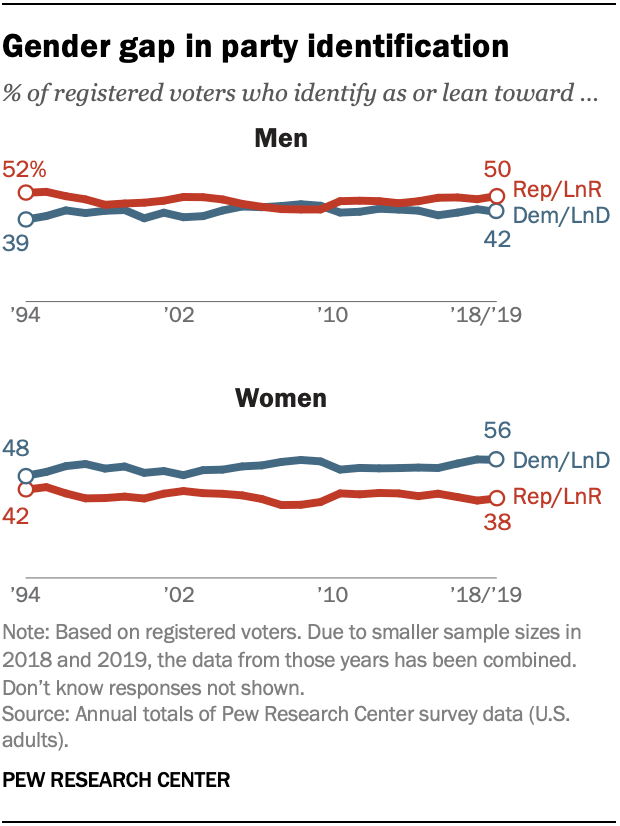
In addition to the gender gap in voter turnout, partisan preferences differ widely by gender. Pew Enquiry Eye survey data going back more two decades shows a growing gender gap in partisan amalgamation. In 2018 and 2019, the Democratic Party held a wide advantage with women: 56% of female registered voters identified equally Democrats or leaned toward the Democratic Party, while 38% identified as Republicans or leaned toward the GOP. This stands in dissimilarity to men, among whom fifty% were Republicans or GOP leaners and 42% identified equally or leaned Democratic. This gender gap has been slowly growing wider since 2014.
Party affiliation, like voter turnout, differs significantly by race and ethnicity. Within each racial and ethnic grouping, however, at that place is a gender gap in partisan identification; in each case, women are more probable than men to identify equally Democrats.
White women have been more than likely than White men to identify every bit Democrats over the past several decades, though the gender gap has grown over fourth dimension. In 2018 and 2019, 48% of White women identified as Democrats, compared with 35% of White men. Past comparison, White men were more likely to place as Republicans than White women in 2018 and 2019 (58% vs. 47%).
Among Hispanic voters, majorities of women and men identify equally Democrats, just this is especially the case among Hispanic women (67% identified every bit Democrats vs. 58% of Hispanic men in 2018 and 2019). Similarly, Blackness women (87%) were more than likely than Black men (77%) to identify as Democrats, even though large majorities of both did so. In 2018 and 2019, the gap between Black women and Black men identifying every bit Democrats was the widest it has been since measurement began.
The gender gap in partisan identification also varies by educational attainment. Men and women with a bachelor's degree or more than education are significantly more Democratic in their orientation than 25 years ago. Still, college-educated women (65%) were much more likely than college-educated men (48%) to identify as Democrats in 2018 and 2019.
Amidst less educated voters, the Democratic Party holds an border with women (51% of women without a college degree identified every bit Democrats vs. 42% who identified every bit Republicans), while men without a degree were more than likely to identify as Republicans (52% vs. 40% who identified equally Democrats). This represents a marked gain for the GOP among men without a college degree. Every bit recently as x years ago, this grouping was roughly evenly split betwixt Democrats and Republicans. Republican gains among men without a college degree have been driven by a growing edge among white men in this grouping.

How Many % Of Women Are Registered Voters In California?,
Source: https://www.pewresearch.org/fact-tank/2020/08/18/men-and-women-in-the-u-s-continue-to-differ-in-voter-turnout-rate-party-identification/
Posted by: manningnowbod00.blogspot.com
0 Response to "How Many % Of Women Are Registered Voters In California?"
Post a Comment